

The pliers section of any jewellery-tools shop is a confusion trap. Round-nose, chain-nose, flat-nose, bent-nose, snipe-nose, half-round, parallel-action, ergonomic, mini, optical, anticlastic — eighty SKUs, all of them claiming to be "essential". For someone setting up their first bench, the question is simple: what do I actually need to buy first?
Spoiler: four pliers will cover 90% of bench work. The remaining 10% is specialty work that you'll add to over years, not weeks. This guide tells you what those four are, what makes a serious jeweller's plier different from a hardware-store plier, and where parallel-action pliers (the ones that look mechanically odd compared to normal pliers) genuinely earn their keep.
Walk through the Pliers & Cutters collection with this in hand and you'll know exactly what's worth buying and what to skip.
Bench (lever-action) vs parallel-action: what's mechanically different
A normal plier — what I'll call "bench" or "lever-action" pliers — pivots on a single point near the jaw. As you squeeze the handles together, the jaws close at an angle: the tips meet first, then the base of the jaw closes behind them. For pointy, gripping work this is fine — for grasping wire to twist, opening a jump ring, holding a stone in place — the jaws don't need to be perfectly parallel.
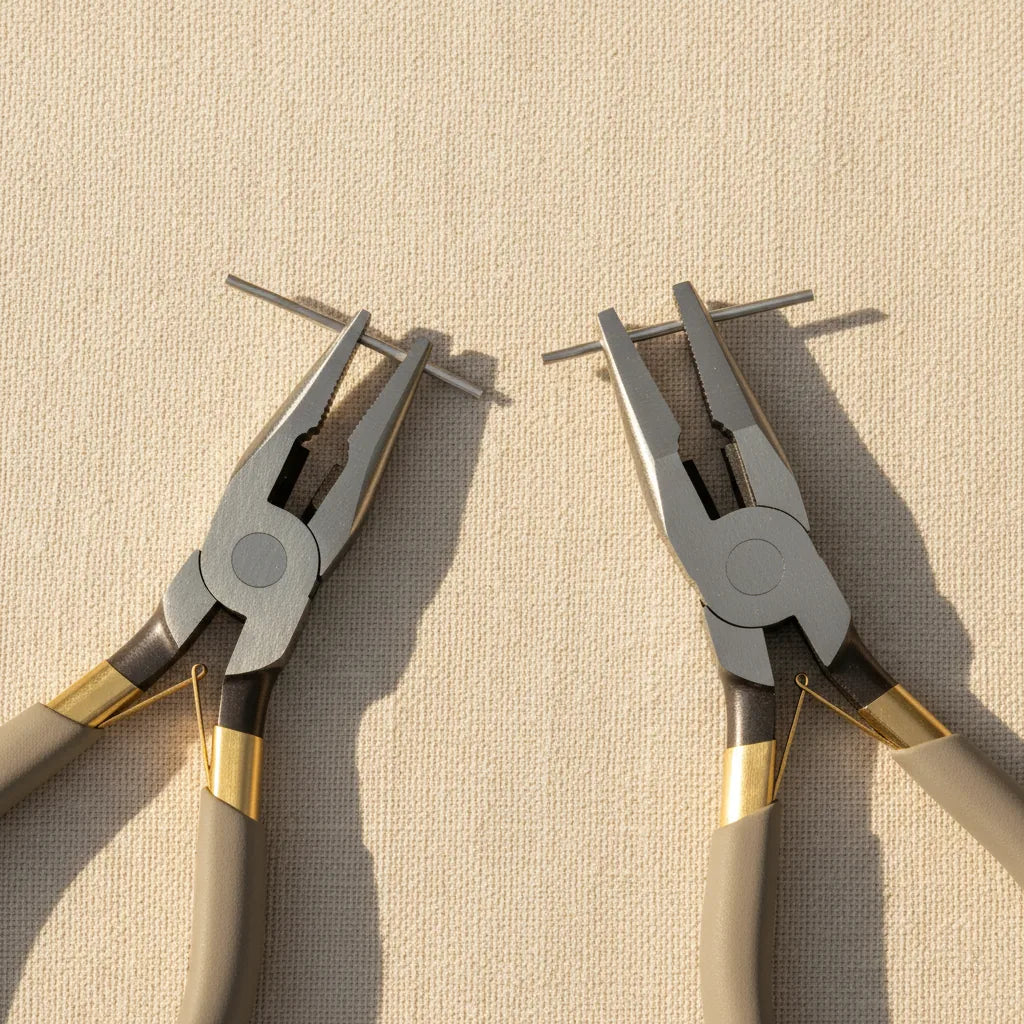
A parallel-action plier has a compound linkage that keeps the jaws perfectly parallel through the entire close. The mechanism uses two pivot points and a sliding link, so as you squeeze, both jaws move toward each other in straight lines, not in an arc.
Why this matters for jewellery:
- Pressure distribution. A lever-action plier gripping a square wire concentrates force at the jaw tip. A parallel-action plier distributes the same force across the whole jaw width. The wire doesn't get marked or distorted at one point — useful for forming work where you need to bend without crushing.
- Square / sheet stock. Bending sheet metal or square wire with a normal plier marks the edge where the jaw makes first contact. Parallel jaws bend the whole section evenly.
- Beginner ergonomics. Parallel jaws are more forgiving of awkward grip — you don't have to position the wire at exactly the right depth in the jaws to get a clean hold.
The trade-off: parallel-action pliers are mechanically heavier, slower to open and close, and harder to use one-handed in a tight setting. For quick gripping and twisting on round wire, a good lever-action plier is faster.
So the real answer to "which to buy first" is neither exclusively — you want both, but you want the right both. Below is the combination I'd recommend.
The four pliers I'd put on a starter bench
In priority order.
1. A 140 mm chain-nose plier (the workhorse)
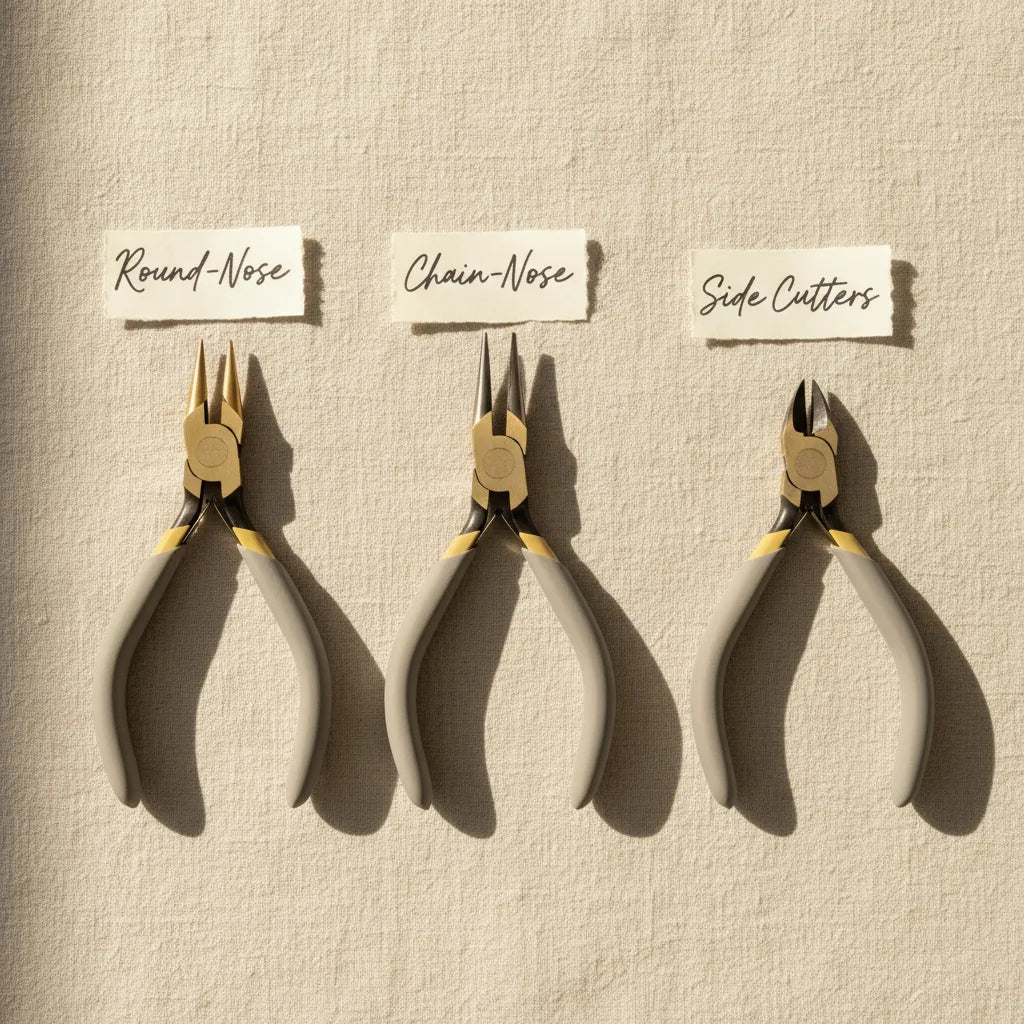
If you can only have one plier in your toolbox, this is it. Chain-nose pliers have flat, smooth, tapered jaws — long enough to reach into tight spaces, flat enough to grip a chain link or jump ring securely without marking it. Smooth jaws are critical for jewellery work: serrated jaws (which most DIY chain-nose pliers have) chew up the surface of every piece you grip.
We stock several smooth-jaw chain-nose options; the one I'd start with is the ergonomic 5.5" smooth nylon chain-nose pliers — PVC grips, stainless steel, smooth tapered jaws. Step up to the PVC-grip parallel-action smooth chain-nose 200 mm once you start forming wire — same form factor, parallel-action mechanism, properly serious tool.
What to test: close the pliers under bright light. The jaw tips should meet without a visible gap, and the inside of the jaws should be mirror-smooth — no machining marks, no edges.
2. A round-nose plier (the loop former)
Round-nose pliers have two conical jaws that taper from base to tip. Their entire job is making consistent loops in wire — for ear wires, eye pins, head pin tops, chain links, anywhere a small circle of wire is needed.
The trick with round-nose is consistency: every loop should be the same diameter as the one before. Cheap round-nose pliers have inconsistent taper, so the diameter of the loop depends on where in the jaw you held the wire — a recipe for mismatched earrings. The round-nose accu-loop pliers have marked diameter steps (2 mm, 4 mm, 6 mm, 8 mm) on the jaw — so you can hit a chosen loop size every time. For pure loop work this is worth every penny over a plain conical pair.
3. A flat-nose plier (the gripper / bender)
Flat-nose pliers have square-cross-section jaws — flat top and bottom, flat sides. Their use is everything chain-nose can't quite manage: holding flat stock without rotation, making 90° bends in wire, opening tight jump rings without flexing the metal back on itself.
I'd start with a 140 mm stainless flat-nose with 1.5" jaws — long jaws mean a wider gripping surface, which means less marking. Add the parallel-action half-round and flat-nose 125 mm (one round jaw, one flat) when you start ring forming — it's a beautiful tool for shaping ring shanks on a mandrel.
4. Side cutters (the fourth, not optional)
Not strictly a plier, but they live in the plier rack. Side cutters cut wire flush — you want a clean, square, mark-free cut every time. A jeweller's side cutter has hardened, ground jaws that meet at a precise angle, leaving one side of the cut flush and the other slightly pinched (so position the flush side toward the keeper piece).
We don't currently stock a dedicated side cutter in the collection we're discussing — Cooksongold's flush cutter is the trade standard in the UK. Don't economise here; cheap cutters dull within weeks and leave burrs that take ten minutes per piece to file off.
Where parallel-action pliers genuinely earn their keep
Now the specifics — when parallel-action pliers shift from "nice to have" to "essential":
Bending square or rectangular wire. Lever-action jaws crush a corner of square stock at the bend point. Parallel jaws distribute the bend across the whole section width. Mandatory for any architectural ring or stacker work.
Forming sheet metal. Bending strips of 0.5–1 mm silver sheet into pendants, frame components, bezel walls. Parallel jaws bend the whole strip evenly; lever-action jaws crease one edge and leave the other side proud.
Hammer-finished wire that needs straightening. Once you've hammered a wire flat, parallel-action nylon-jaw pliers (see next section) are the only way to straighten it without re-marking. Our parallel-action nylon-jaw flat-nose 140 mm is the right tool — and the extra-jaw set means you can swap in fresh jaws as the originals scuff.
Where they're the wrong choice: quick gripping for chain repair, opening jump rings, any one-handed work, and any time you're working in a tight setting between stones. The compound linkage adds bulk to the jaw width — sometimes too much for the space available.
Nylon-jaw pliers: the secret weapon
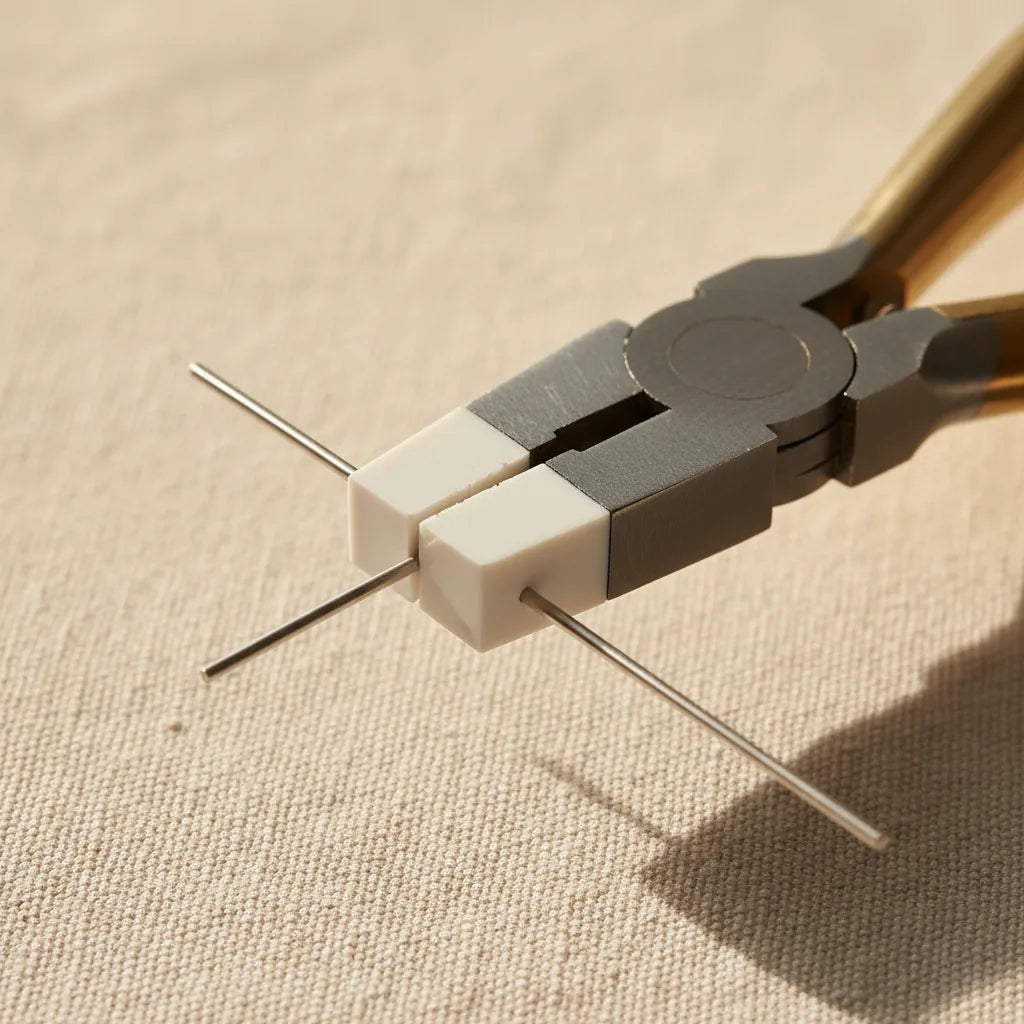
Nylon-jaw pliers have replaceable plastic jaw inserts in place of steel. They grip wire without marking the surface at all — invaluable for:
- Straightening kinked wire before drawing it through a draw plate
- Holding finished pieces while you work on adjacent areas
- Tensioning wire during wire-wrapping without leaving a single mark
The catch: nylon jaws wear out and need replacing periodically. Buy the premium flat-nose with double nylon jaw 160 mm version that comes with extra jaws so you're not stuck mid-project. Once you've used nylon jaws on a finished piece you can't un-know how good they are.
What to skip until you need it
This is where most beginner guides fail you — they list every plier on the shelf. Don't buy these in your first year:
- Bail-making pliers. Specialised for forming consistent wire bails (the loop on top of a pendant that the chain runs through). When you're making your fifth pendant, get a mini bail-making pliers 4 1/4" and you'll wonder how you managed without. Before then, a round-nose plier does the job adequately.
- Wire-wrapping (stepped) pliers. Multi-diameter stepped jaws for making loops at exactly 3 mm, 4 mm, 5 mm. The 3-step wire-wrapping pliers are a year-two purchase — useful once you're producing matched sets.
- Anticlastic pliers, ring-bending pliers, optical glass-chipping pliers, watch-repair pliers. All specialty — buy when you take on the specific work, not before.
- Bent-nose / snipe-nose / "ergonomic" variations of pliers you already own. Resist the temptation. A second chain-nose plier in a different jaw angle is procrastination dressed as kit acquisition.
When you outgrow the starter four, the next purchases are usually (in order): nylon-jaw flat-nose, bail-making, side cutters of a second size (heavy-duty), then a specialty plier for the technique you're learning.
What separates a jeweller's plier from a hardware plier
Three things, in order of importance.
Smooth, machined jaws. No serrations, no machining marks, no edges. Hardware pliers have serrated jaws on purpose — for grip on raw work pieces. On jewellery wire, those serrations transfer onto every piece you grip, leaving permanent marks. The jaw faces should be polished and meet without a visible gap when closed.
Spring loading. A jewellery plier should spring open on its own. You should be using your hand to close it, not to fight it open every cycle. This is a wrist-fatigue thing — over a long bench session, hardware pliers without springs leave your forearm aching by the third hour.
Box-joint construction. The pivot should be a precision box joint (interlocking forks), not a single rivet through stamped halves. Box joints stay tight for decades; stamped rivets develop slop within a year of heavy use and the jaws stop meeting correctly.
The British Jewellers' Association's bench-skills handbook (the BJA publishes free guidance through their professional development resources) covers plier selection in detail — worth reading once you've owned the four for a few months and want to deepen.
Frequently asked
Do I really need both chain-nose and flat-nose pliers?
Yes. Chain-nose taper to a point — good for tight spaces and chain links. Flat-nose have square jaws — better for straight bends, holding flat stock, opening tight jump rings. They overlap maybe 30% — the other 70% is genuinely different work.
Are parallel-action pliers worth the extra cost for a beginner?
For your first month, no. Start with good lever-action chain-nose and round-nose. Once you've made a few pieces and your hands have learned what's hard about jewellery work, a single parallel-action plier (chain-nose or flat-nose) transforms forming work. Don't buy two parallel-action pliers before you own four good lever-action ones.
Why do my pliers leave marks on silver wire even though they look smooth?
Three usual causes: (1) jaws aren't actually smooth — run a fingernail across them; (2) you're gripping too tight; (3) you should be using nylon-jaw pliers for any work on a finished or polished surface. Switching to nylon-jaw pliers for the final fit-up step solves 90% of marking issues.
How long do good jewellery pliers last?
Decades, with the caveat that nylon jaws (where applicable) need replacing every few hundred uses. A good box-joint plier from a reputable maker will outlast its first owner. Cheap stamped-rivet pliers develop joint slop within 6–12 months of daily use.
What about a plier rack — is it worth buying one?
For 4+ pliers, yes. They tangle in a drawer, scratch each other, and you waste seconds finding the right one. The wooden rack we stock holds five pliers visibly and is a one-time bench investment.
Where to go next
Start with the smooth chain-nose 5.5" and round-nose accu-loop. Those two cover everything in your first month at the bench. Add a flat-nose and side cutters by month two, browse the Pliers & Cutters collection for the parallel-action upgrades when you start forming work.
The next post in this cluster, Cutting hardened jewellery wire without damaging your jaws, covers the practical companion skill — how to actually use these pliers without prematurely ruining them.
— K.