

Tweezers are the most-used tool on a jewellery bench by a wide margin. You'll touch one in nearly every operation: holding a setting while you solder, retrieving a hot piece from the pickle pot, gripping a pearl while it sets, placing a stone for a customer to approve. Get the tweezer wrong and the worst-case outcome is a dropped piece into a hot torch flame; the best-case is twenty seconds of fumbling that breaks your rhythm.
The tweezer aisle of a jewellery-tools catalogue is also where most beginners overspend, buying half a dozen because they look similar and the descriptions all sound vaguely useful. This guide is the framework I use to choose: the four tweezer types every bench actually needs, what cross-lock and reverse-action actually mean (and why one of them is rare in the UK), and the three soldering accessories that complete the kit.
Browse the Tweezers & Soldering collection with this in hand. The companion piece, Setting up a hands-free soldering station for the home bench, shows you how to assemble them into a working setup.
What "cross-lock" and "reverse-action" actually mean
A standard tweezer opens when you press its arms together. The spring tension holds them apart at rest; your grip closes them.
A cross-lock tweezer does the opposite: the arms are spring-tensioned closed at rest, and your grip opens them. Squeeze to release the workpiece, let go to clamp it. This is the standard for soldering tweezers because you can clamp the piece, lay the tweezer down on the bench, walk around to your torch, and the workpiece stays gripped without any effort from your hand. Set it and forget it.
A reverse-action tweezer is essentially the same mechanism as cross-lock — clamped at rest, open with grip pressure — and the term "reverse-action" is mostly American. In UK jewellery-tools usage, you'll see "cross-lock" or "self-locking" more often. They mean the same thing.
The distinction that does matter:
- Straight cross-lock vs angled / bent-tip cross-lock: straight tips reach into tight assemblies; bent tips drop the jaws below the line of the handles, useful when you want to clamp a piece flat on the charcoal block without the handles getting in the way of your torch flame.
- Smooth-jaw vs serrated-jaw: smooth jaws don't mark the piece — essential for soldered joins where the tweezer touches a polished surface. Serrated jaws grip more aggressively but leave indentations. For soldering work always go smooth.
- Insulated handles (fibre grip) vs bare metal: insulated cross-lock tweezers stay cool when the jaw end is at solder temperature. Bare-metal cross-locks conduct heat down the handle and burn your fingers within ten seconds of heating the tip. Always buy insulated for soldering.
Our fibre-grip cross-lock tweezers with stand and straight tip is the daily-driver soldering tweezer for that exact reason — the fibre grip stays cool through long sessions, and the dedicated stand keeps the tweezer upright between operations.
The four tweezer types every bench needs
In priority order.
1. Fibre-grip cross-lock soldering tweezers (the daily driver)
The single most-used tweezer at the bench. Used for every soldering operation: holding the workpiece on the charcoal block while you torch the join, picking up a hot piece without your fingers, holding the pick-up wire when you transfer a stone.
Look for: straight or slightly bent tip, smooth jaws, fibre/PVC insulation along at least half the handle length, light spring tension (not so heavy that your hand cramps after an hour).
The serious option is the heavy-duty 8" anti-magnetic Japanese steel soldering tweezers — Japanese steel holds an edge longer, anti-magnetic means hot steel filings don't drag into your join. Buy this once and it outlasts everything else on your bench.
If you're starting out and want a kit, the 8-piece professional soldering tweezers kit gives you cross-lock variants in different tip styles plus a storage case — useful for finding your preferred tip shape before committing to a single tool.
2. Precision tweezers (the placement tool)
For positioning small components — stones, findings, beads, ring-shoulder accents. These are not spring-locked: you grip to close, release to open. The jaws are slim, fine, and unmarked.
Two styles worth owning:
- Smooth-tip stainless steel — for general handling. The precision bent-tip tweezers with rubber grips is the version I use for daily placement work.
- Titanium tweezers — for any work involving hot metals where you don't want sparks, or anti-magnetic work. The 3C-Ti titanium tweezers 108 mm anti-magnetic is the choice for watchmakers and for anyone working with delicate magnetic-sensitive components.
3. Ring-holding tweezers (the soldering specialist)
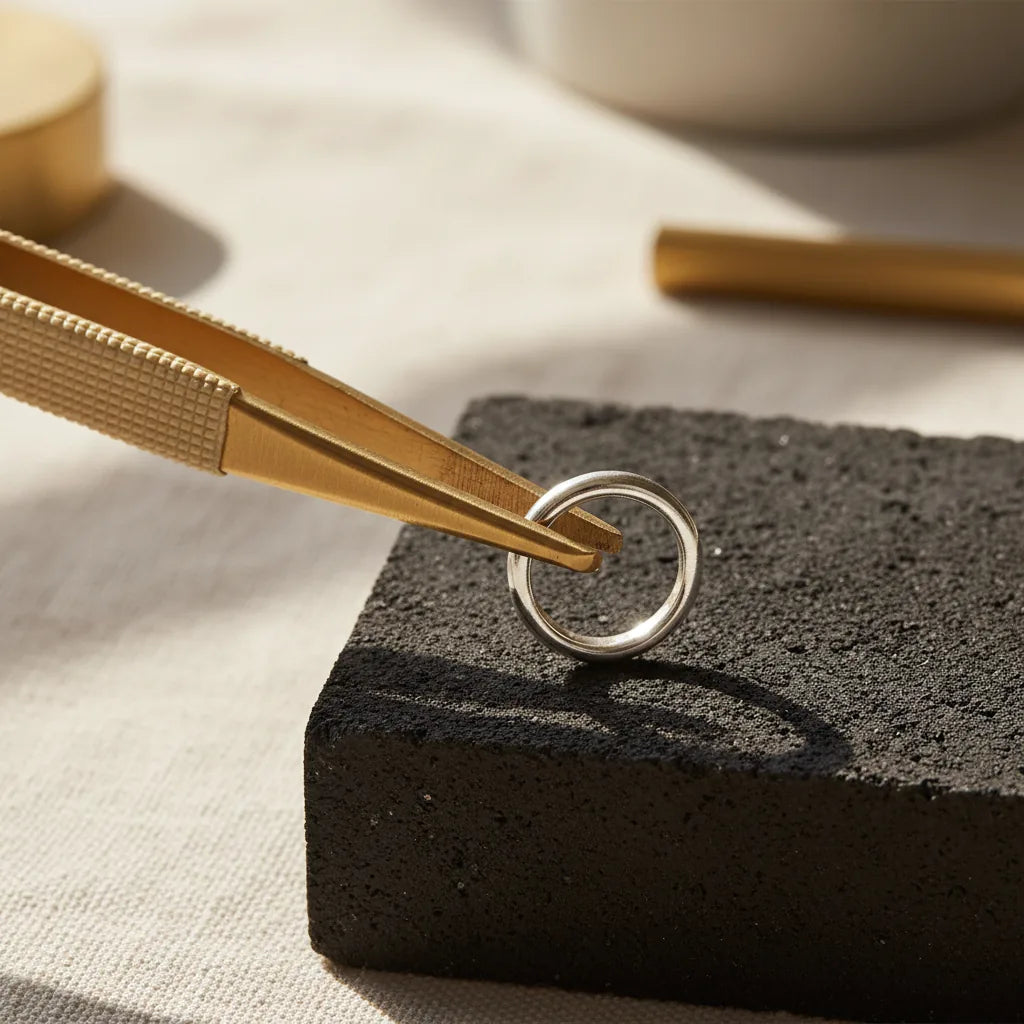
A different shape entirely — these tweezers have a wide, cup-shaped jaw designed specifically to hold a ring securely while you solder its shank. The cup geometry keeps the ring from tilting or shifting when heated.
We stock two sizes: the small ring-holding tweezers 6" with 13×13 mm jaw for most everyday band work, and a larger size for thicker shanks. If you'll be doing any ring-shank repair, ring-resizing solder joints, or band stretching that involves heat — buy one. They cost £6 and save fifteen minutes of fiddly clamping per ring.
4. Pickling tweezers (the corrosion-resistant ones)
The trap most beginners fall into: using their good steel tweezers to retrieve pieces from a hot pickle bath. Pickle (sodium bisulphate solution) reacts with steel — and the copper or iron plates onto every piece that follows into the pot. Two cups of pickle later, every piece is coming out with a salmon-pink coating.
The fix is dedicated copper pickling tweezers — copper is sacrificial against pickle, doesn't contaminate the bath, and the curved tip is shaped for fishing pieces out of the warm liquid without scalding your hand. The British Hallmarking Council's bench-practice notes specifically warn against ferrous tools in the pickle bath; this isn't just bench-folklore.
Where each tweezer type is the wrong choice
Cross-references that prevent the most common bench mistakes:
- Cross-lock soldering tweezers are too coarse for stone setting. Use precision tweezers for any work where a stone touches metal.
- Precision tweezers are not for picking up hot work. The thin jaw and bare-metal handle conduct heat instantly into your fingers. Use cross-lock with insulated grips for anything that's been near a flame.
- Ring-holding tweezers are exclusively for rings. The wide cup is wrong for any other shape.
- Pickling copper tweezers should never touch precious metal for any reason other than pickling. The soft copper picks up tiny amounts of solder, oil, and contamination over time and can transfer them onto polished surfaces.
The soldering accessories that complete the kit
A cross-lock tweezer on its own is half a setup. You also need:
A charcoal block holder. The block reflects heat back onto the workpiece. Without a holder, the block slides on the bench mid-operation. The 120 × 50 mm anti-magnetic stainless charcoal block holder is the right size for benchwork.
A third-hand / helping-hand base. This holds the cross-lock tweezer at an adjustable angle so the workpiece sits stable while you direct the torch with both hands free. The heavy-duty third-hand base with double clamp is the centerpiece of any soldering setup — buy this once and it stays on your bench for the next decade.
A titanium soldering pick. For moving the piece across the block, positioning solder paillons, or nudging a stone into a setting bezel as it cools. The 3-piece titanium pick set in red/blue/yellow gives you three colour-coded picks so you can dedicate one to each solder grade (hard / medium / easy) and never cross-contaminate.
Without these three, you're soldering in slow motion. With them, you'll save 30–60 seconds per join.

What to skip until you actually need it
The "Tweezers & Soldering" aisle is full of specialty items. Hold off on these:
- Anti-static / ESD tweezers. Useful for electronics, not jewellery work. The watch community uses some but a regular precision tweezer covers nearly all jewellery tasks.
- Long-reach 180 mm shovel tweezers. Specialised for handling stones in bulk — pearl strands, sapphire parcels — when you're working at volume. A year-three purchase.
- Split-ring tweezers. Wonderful for jewellery repair work involving split rings (think keyring-style closures), not used in original-piece making. Skip until a repair customer brings one in.
- PVC-coated heavy-duty tweezers for ultrasonic cleaning. Useful if you have an ultrasonic cleaner. If you don't have one yet, you don't need these.
Frequently asked
Do I need both cross-lock and precision tweezers, or can one do both jobs?
Both. Cross-lock for heat / pickle / setting where the piece needs to stay clamped; precision for placing components and stones where you want immediate control. Trying to substitute one for the other is the source of most beginner soldering mistakes.
Why are anti-magnetic tweezers more expensive?
Standard stainless tweezers pick up a residual magnetic charge over time, which then drags steel filings or magnetic dust onto every piece you touch. Anti-magnetic stainless or titanium tweezers don't develop this charge — useful for watchwork, where stray magnetism can affect movements, and for any precision work where contamination matters. For everyday hobbyist work, standard stainless is fine; for production or watch work, anti-magnetic is worth the extra.
What's the difference between titanium and stainless tweezers?
Titanium: lighter, completely non-magnetic, doesn't spark against hot work, more expensive. Stainless: heavier, can pick up a residual magnetic charge, sparks against hot work in a way that can matter for fine soldering, cheaper. Titanium is the right choice for watchwork and any fine soldering with steel-sensitive components.
How do I clean my tweezers?
Rinse in water after pickle exposure (dry immediately or you'll get water-spot corrosion). For solder residue on the tips, fine emery paper or a soft brass brush. Never use abrasive on the jaw faces of precision tweezers — you'll lose the precision tip.
Why do my cross-lock tweezers stop staying closed?
The spring tension has either fatigued (years of use) or the jaws have been forced past their stop and bent slightly. Bent jaws can sometimes be corrected with careful pressure on a steel anvil; fatigued springs are not field-repairable. Replace.
Where to go next
Start with the fibre-grip cross-lock with stand, the precision bent-tip tweezers, and a pair of copper pickling tweezers. Those three cover all the soldering and pickle workflow.
The next post in this cluster, Setting up a hands-free soldering station for the home bench, shows you how to assemble these into a working setup that doesn't burn through your weekend.
— K.