

Watch hand removal is the operation where amateurs lose dials. The hands sit on tiny pressed-fit tubes called the "cannon pinion" (minute hand), "hour wheel" (hour hand), and "fourth wheel pinion" (seconds hand). They're held in place only by friction — and the lift force needed to break that friction is just enough that an off-aim or off-angle pull will scrape, dent, or scratch the dial directly underneath.
A dial scratch is unfixable. The dial is the visible face of the watch, the most expensive part to replace, and on vintage pieces, the source of the watch's value. Get this wrong on a customer's piece and you're either eating a £200-800 dial replacement or refusing the work entirely.
This guide is the honest amateur version: when you can do this yourself, when you absolutely cannot, the technique that minimises risk, and how to recover if it goes wrong. Read all the way to the bottom before attempting on any watch you care about. If you've not already read the companion Watch-repair starter kit, start there for the tool context.
A direct warning before you start
Three categories of watches where you should NOT attempt amateur hand removal:
1. Vintage watches (pre-1980s). Dials are often painted enamel or radium luminous. Tools touch them, paint chips, value evaporates. Hand them to a qualified watchmaker.
2. High-value modern watches (Rolex, Omega, IWC, Tudor, etc.). Even a tiny scratch on a £3,000+ watch's dial destroys substantial value. The professional service cost is justified by the risk profile.
3. Watches with delicate or unusual dial features. Domed dials, applied-index dials with raised markers, blue-paint or guilloche-pattern dials. The protective tools assume a flat, painted dial; they fail on more complex surfaces.
For everything else — modern quartz, modern mechanical sports watches, fashion watches, your own watches you'll wear once they're working — proceed with care.
What you actually need
Real talk: the proper tool for hand removal is a hand puller (sometimes called a "presto" tool — a small cylinder with twin spring-loaded levers that grip under the hand boss and lift it straight off). The trade-standard is the Bergeon 5074-G (about £80 in the UK). We don't currently stock this — it's specialist watchmaking gear and our Watch & Clock Tools collection leans amateur. UK sources for the Bergeon: H.S. Walsh & Sons, Cousins UK.
The amateur alternative is two thin pry levers — like the steel scribe with wooden handle band pin pusher used as a lifter against another flat tool. It works on robust modern watches; it's a higher-risk approach than a proper hand puller.
The full kit for the technique below:
- Watch held in a wooden case holder — case must be perfectly stationary; any movement during the lift can scratch the dial
- A 10× loupe — the 10×21 mm jeweller's loupe is the right magnification. You can't do this work by eye alone
- Dial-protection sheets — thin plastic film cut to fit over the dial with slits for the hands to poke through. Either buy specialist "dial protectors" or improvise with two pieces of cigarette paper (yes, really — it's a long-standing trade trick). These prevent the levers from scratching the dial surface
- Anti-magnetic titanium tweezers — for handling the hands once they're removed. Magnetic tweezers would magnetise the steel hands and cause them to grab the movement on reinstallation
- A clean velvet or chamois pad — for placing removed hands. Loose hands roll into bench creases and get lost
- The 16-piece watch repair kit — has the basic lever tools you'll use if no hand puller is available
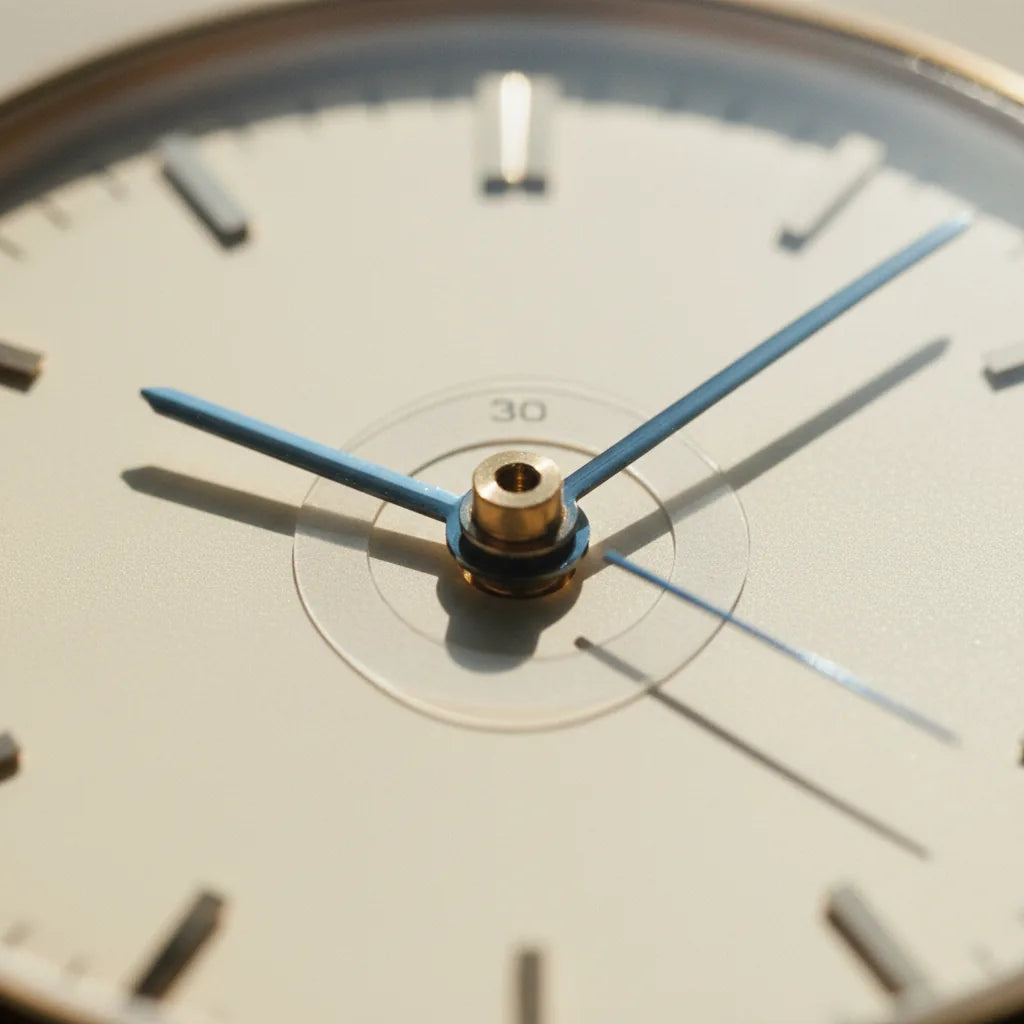
The technique
The order of removal is fixed: seconds hand first, then minute hand, then hour hand. The seconds hand sits highest and outermost; minute hand sits below; hour hand sits closest to the dial. Removing them in this order avoids damaging upper hands while pulling lower ones.
Step 1 — Prepare the watch
Open the case-back (different procedure depending on whether it's snap-back or screw-back — the 16-piece kit has openers for most snap-back types). With the back off, locate the lever that holds the movement in the case — usually a small steel clip on one side. Lift the movement out gently from the case-back side.
Place the movement face-up in the wooden case holder. The case holder grips the case ring (or the movement directly if no case ring), keeping the dial level.
Step 2 — Position dial-protection sheets
Cut two sheets of thin plastic film (or cigarette paper) to fit between the watch hands and the dial. Slit them so they slide around the hand stems and lay flat on the dial. With the protection sheets in place, your levers will touch the protector, not the dial — even if they slip.
This is the single most important step. Never attempt hand removal without dial protection. A 30-second protection-sheet install prevents a £200 dial replacement.
Step 3 — Locate the seconds-hand boss
Under the loupe, find where the seconds hand attaches to the central pinion. The boss is the slightly-thickened section at the centre of the hand. You'll be lifting from under this boss.
Step 4 — Position the levers
The two-lever technique:
- Insert lever #1 from one side, sliding the tip under the seconds hand boss, with the lever resting on the dial protector
- Insert lever #2 from the opposite side, same depth, mirror angle
- Both lever tips should be under the boss, on opposite sides, with the levers themselves resting flat on the dial protection sheet
The levers form a "wedge" under the hand. The boss sits in the wedge angle.
Step 5 — Lift simultaneously
Press down equally on the lever handles. The levers rotate as a pair, the wedge tips rise under the hand boss, and the hand lifts straight up off the pinion.
Critical: lift straight up, not to one side. If one lever lifts faster, the hand tilts and can either bind on the pinion (won't come off) or scratch the pinion surface as it twists.
The seconds hand should pop free with a barely audible click after maybe 100 g of force per lever. If you're pressing harder than that and nothing moves, stop — something is wrong (wrong angle, wrong leverage, or the hand is corroded onto the pinion).
Step 6 — Place the hand
Lift the seconds hand free with the titanium tweezers. Place it on the velvet pad, paying attention to orientation if the hand isn't symmetric. Photograph the dial before each step — you'll need the photo as reference when re-fitting.
Step 7 — Repeat for minute and hour hands
Same technique. The minute hand is held by the cannon pinion (lighter friction than the seconds-hand attachment); the hour hand sits on the hour wheel (loosest friction, comes off easiest).
Each subsequent hand is on a slightly thicker pinion — adjust your lever depth accordingly.
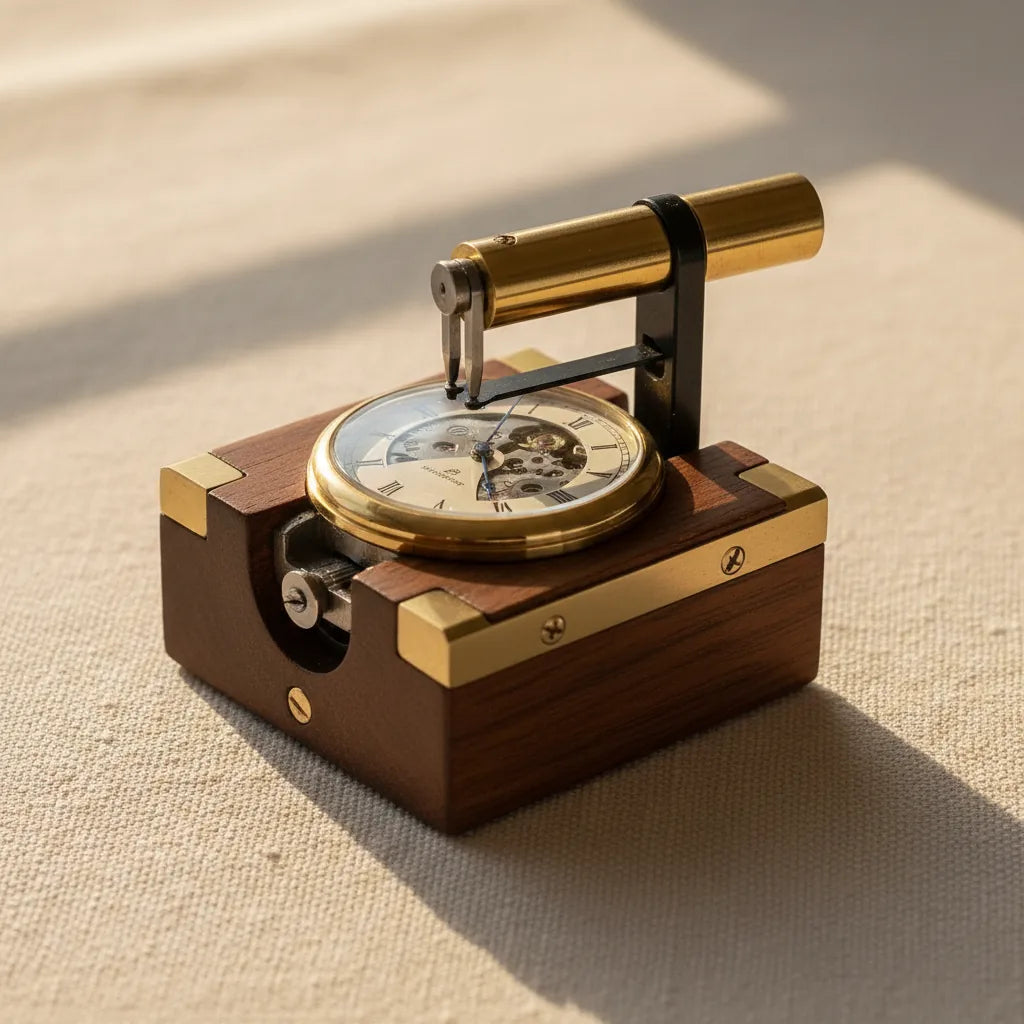
Common failures (and recovery, where possible)
The hand won't come off
Causes: corrosion on the pinion (the hand has been on for decades and oxidised in place); excessive force was used during original installation; the hand boss is partially closed (some hands are crimped to grip more tightly).
Recovery: a tiny drop of penetrating oil (clock oil, not WD-40) on the pinion-hand interface, wait 5 minutes, retry. If still stuck — stop. Sending a frozen-hand watch to a watchmaker costs less than scrapping a dial trying to force it.
A lever slipped and touched the dial
Stop immediately. Under the loupe, inspect the touch point. Most modern dials have a hard lacquer coating that resists a single light scrape — you may have got away with it. Older or softer dials can show a hairline mark even from light contact.
If there's no visible mark, continue carefully. If there's a mark, stop the operation. Whether the watch is finished depends on whether the dial can be cleaned (very minor surface marks) or whether it's now a refinish-or-replace job (for visible scratches).
The hand bent on lifting
Recovery: gently straighten with titanium tweezers (anti-magnetic, to avoid magnetising the steel). Look at the hand under the loupe for any creases — a bent steel hand can be straightened; a creased aluminium hand often can't be made level again. Replacement hands are available from movement suppliers for most modern calibres; vintage replacements are harder.
The pinion tip broke
Catastrophic failure. The pinion is part of the watch movement; replacing it requires watchmaker-level work and a parts source for the specific calibre. Hand the watch to a professional with photos of the original disassembly.
When to stop and call a professional
Three signals it's time to bow out:
-
You've spent more than 15 minutes on a single hand without progress. Force is not the answer; expertise is.
-
The watch is worth more than your hourly bench rate × the time it would take a professional. A £30 quartz watch — your time. A £300 mechanical watch — a professional's time.
-
You're already past the point where you can re-fit what you've taken apart. This is the moment to put the parts in a bag, photograph the disassembly state, and find a watchmaker who'll inherit the job.
The BHI (British Horological Institute) directory lists qualified UK watchmakers by region. Most charge £50–£150 for a "rescue the amateur" job, which is almost always less than the dial replacement you'd otherwise need.
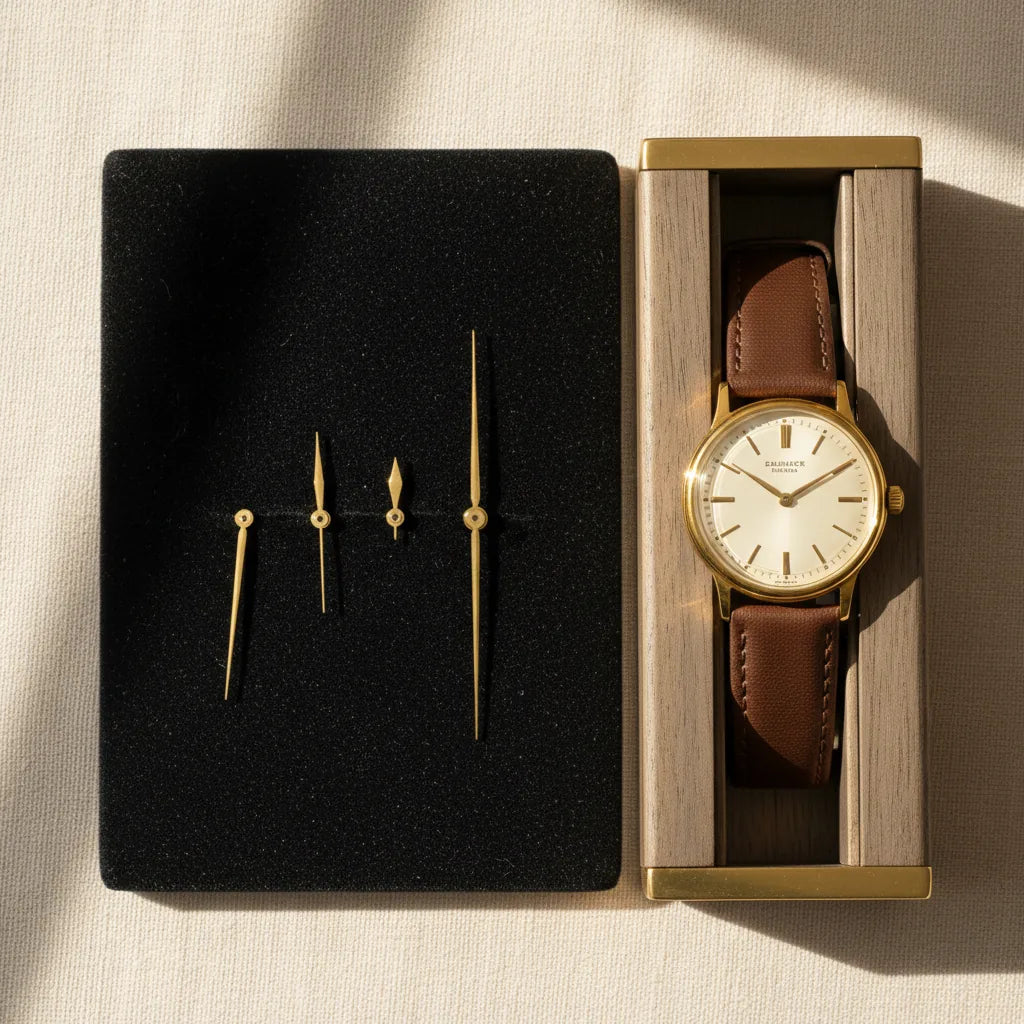
Re-fitting hands (the reverse procedure, briefly)
The reverse of removal is pressing hands back on — and it's its own art. Brief notes:
- Each hand has a friction-fit hub that sits on its pinion. Press it on by hand or with a specialist hand-fitting tool (a small flat-tipped pusher with a hole in the centre to clear the pinion)
- The hands must all be aligned correctly: when the crown is set to 12:00, all three hands should point straight up
- Hands must not touch each other or the dial — the hour hand sits closest to dial; minute hand above it; seconds hand on top. They need clearance between layers
- After fitting, check the watch runs through a full 12-hour cycle without the hands clashing — sometimes a slightly off-clearance hand catches on another at 3:00 or 9:00
Re-fitting is more forgiving than removal because the pressing force compresses the hand onto the pinion rather than pulling against the dial. But it's still possible to bend a hand or misalign it. Practice on a scrap movement before working on a watch you care about.
Frequently asked
Can I remove watch hands with two pieces of plastic instead of a hand puller?
Yes, with care. The risk is asymmetric force — one side lifts faster than the other and the hand tilts. A proper hand puller applies even force; two plastic levers require very steady hands and a slow lift.
Will I damage the watch if I just pull the hands off with my fingers?
Almost certainly. Finger grip transfers oils, the lift won't be straight, and there's no way to apply protection to the dial. Don't.
What's the friction force on a watch hand?
Typically 50–200 g lift force, depending on hand size and pinion fit. A few percent of a kilo. Light enough to come off with proper tools; heavy enough that finger-and-thumb won't manage cleanly.
How do I tell if a watch is too valuable to amateur-service?
Three quick checks: (1) brand on the dial — if it's a Swiss luxury brand, take it to a professional; (2) age — pre-1990 mechanical watches generally to a professional; (3) any luminous compound — vintage radium dials are hazardous AND fragile; never attempt.
Where do I buy replacement watch hands if I bend the originals?
For modern movements (ETA, Sellita, Miyota, etc.), Cousins UK and HSW Walsh stock hands in standard sizes by movement calibre. For vintage, eBay parts auctions or specialist vintage parts dealers — supply is unpredictable.
Where to go next
If you're at the "I want to learn this properly" stage, the British Horological Institute offers home-study courses leading to recognised qualifications. The full pathway takes 2–4 years part-time and covers everything from amateur repair through to full Swiss-trained watchmaking.
If you're at the "I just want to fix the watches I own" stage, the watch-repair starter kit guide covers what to buy first, and the Watch & Clock Tools collection has the amateur-friendly tools to start with.
— K.