

Let me be straight with you: full watchmaking is a different discipline from jewellery making, and a true watchmaker's bench takes a different kit (and several years of training) than what's on our Watch & Clock Tools collection. What we stock — and what this guide covers — is the amateur end: strap adjustments, band-link removal, case-back opening, basic case holding, anti-magnetic tools for handling movements. Enough for the work that 90% of watch owners actually need: a too-large bracelet, a stuck case-back, a spring bar that needs replacing, a battery change.
If you're aiming for full watchmaking — escapement servicing, balance staff replacement, mainspring winding — you're in another world (and need a clean room, a microscope, specialist tweezers, oils, and a £200+ Bergeon spring bar tool). We'll point you toward UK trade suppliers like H.S. Walsh and Bergeon for that level. But for the kit that gets a hobbyist or jeweller through everyday watch tasks, this guide covers it.
What this kit will let you actually do
Be realistic about the work this covers:
Yes, you can do:
- Resize a metal bracelet (remove or add links)
- Change a leather strap (replace spring bars, fit new strap)
- Open and close most screw-back and snap-back cases
- Replace a watch battery (with care)
- Clean exterior case parts in an ultrasonic
- Position a watch for inspection / photography
No, you can't (without much more specialist kit) do:
- Open a press-fit caseback (needs a specialist case press)
- Service a mechanical movement (needs a watchmaker's lathe, mainspring winder, oils)
- Replace a crystal (needs a crystal press)
- Demagnetise a watch (needs a demagnetiser)
- Time-test a movement (needs a timegrapher)
For everything in the "yes" list, the kit below is enough.
The starter kit (in priority order)
If you can only afford one thing, get the first item. Each subsequent purchase adds capability without obsoleting the previous one.
1. A 16-piece watch repair tool kit
The single best entry-point. The 16-piece watch repair tool kit with pin remover and wrist strap adjuster gives you:
- A spring-bar tool (for strap replacement)
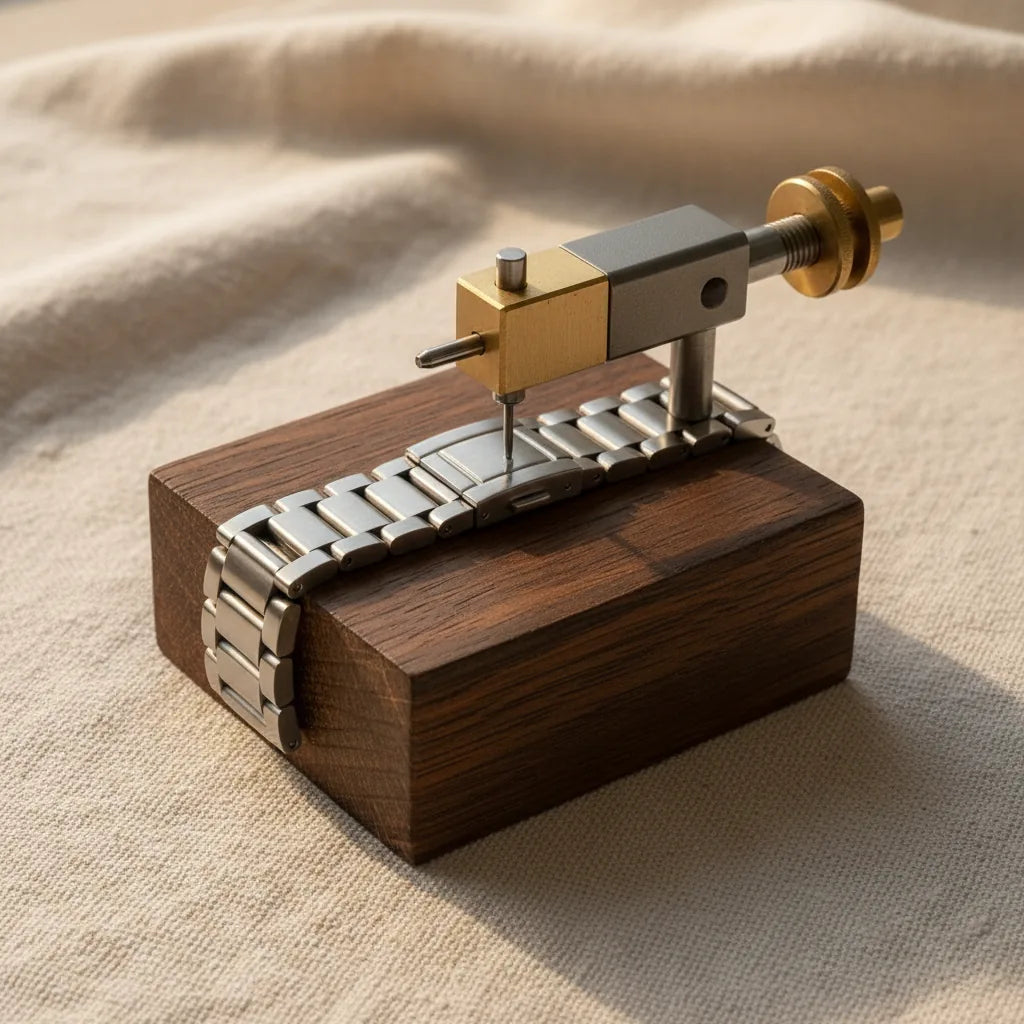
- A band-link pin removal jig
- Replacement spring bars in common sizes
- A case-back opener (basic, snap-back type)
- A small screwdriver set
- A wrist strap adjuster (the block that holds the bracelet while you knock pins out)
For under £20 you can do strap and bracelet work, basic case opening, and small screw adjustments. This single kit handles 80% of amateur watch tasks.
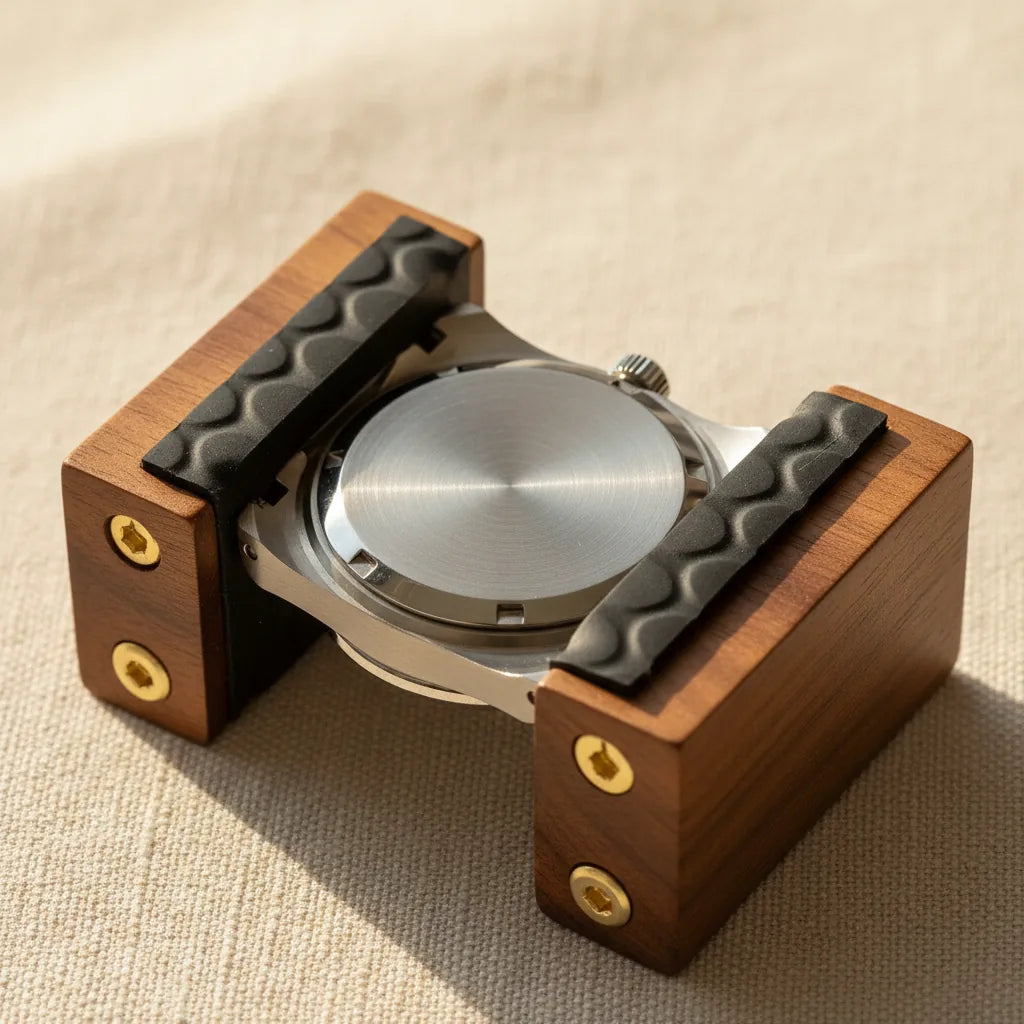
2. A wooden watch case holder
The kit's strap adjuster is fine for bands; for case work you want a proper holder. The wooden watch case holder clamp, rosewood 8 × 5.5 cm is sized for most wrist-watch case diameters (28–45 mm) and grips the case sides without marking the bezel finish.
Wood is the right material for two reasons: (1) it won't scratch the case; (2) it's anti-magnetic, important if you ever have the back off the watch with the movement exposed.
3. Anti-magnetic titanium tweezers
For any work where the movement might be exposed (case-back open, even briefly), magnetic tools are a hazard — a single magnetic touch can imprint a residual magnetism on the balance hairspring and stop the watch from keeping time. The 3C-Ti titanium tweezers 108 mm anti-magnetic is the right grade.
You won't always need these — for strap work, basic stainless tweezers from your jewellery kit are fine. For case-back-open work, anti-magnetic is essential.
4. A jeweller's loupe (10×)
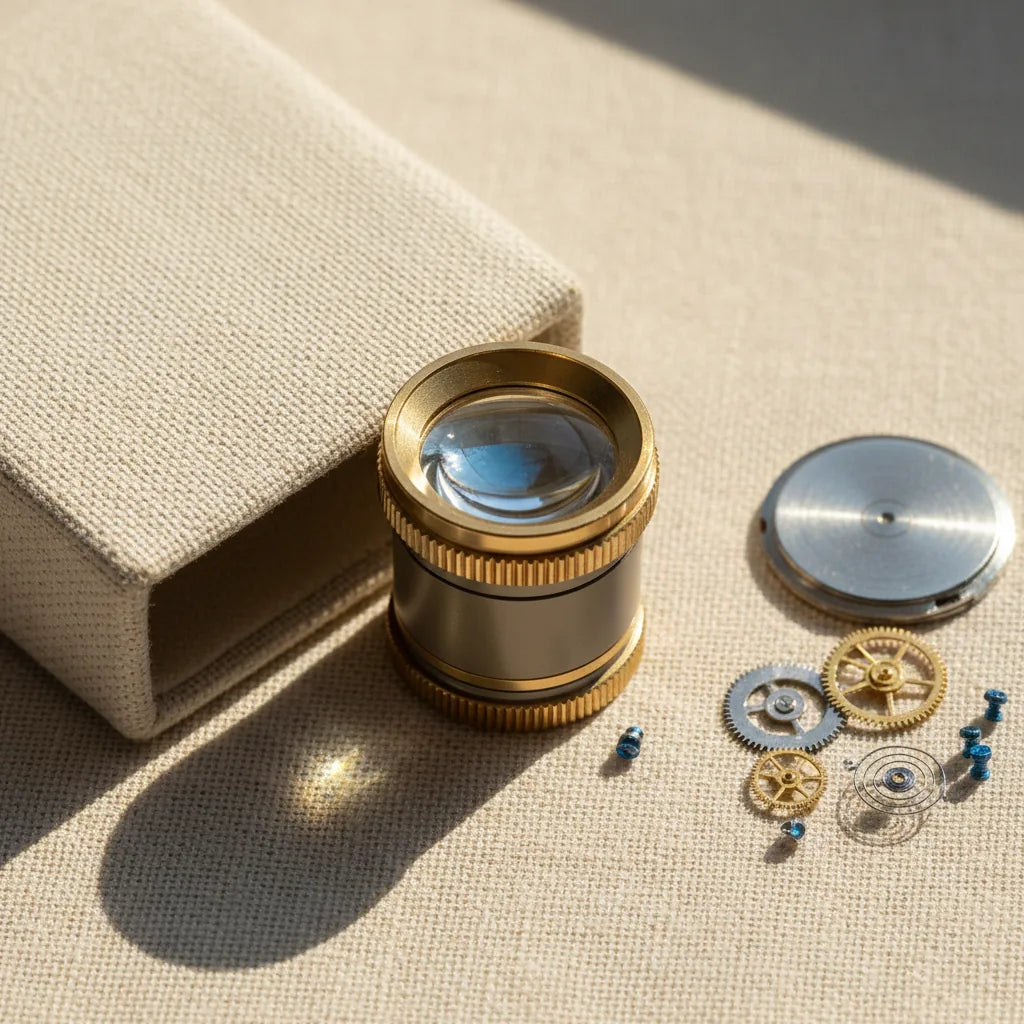
You can't see what you're doing on watch parts without magnification. The jeweller's magnifying glass loupe 10×21 mm with case is the standard amateur loupe — 10× is the right magnification for case detail, lug spring-bar holes, and movement components (you can see them, even if servicing is out of scope).
Don't substitute reading glasses or phone magnifier apps; both fail at the depth-of-field a real loupe provides.
5. Watch repair pliers + band pin pusher
For more frequent strap work, two specialty tools:
- The watch repair pliers 5.25" stainless — spring-loaded, ergonomic, designed specifically for compressing spring bars during strap fitting. Faster than the basic spring-bar tool from the 16-piece kit.
- The band pin pusher steel scribe with wooden handle — for driving the pins out of metal bracelet links. The kit's pin-pusher works, but this one is sharper and lasts longer.
Add these when you're doing strap work weekly or more.
6. Dedicated band-link tools
For volume bracelet resizing, the watch band link removal tool, metal pin strap adjuster is a jig version that aligns the bracelet, the pin, and the punch in one operation. Faster than freehanding once you have the technique.
The watch wood bracelet holder for band link removal is the gentler version — wooden body, won't scratch a polished bracelet finish.
7. Specialty pliers — spring-bar forming
If you start making custom bracelets or fitting unusual strap configurations, the spring-bar pliers with concave/convex jaws shapes spring bars to fit curved lugs. A year-two purchase once you're producing custom-band work.
What you DON'T need yet
The watchmaking rabbit hole is deep and full of expensive gear. Hold off on:
- A case-back press — for snap-fit casebacks. Useful, but the manual case-back opener in the 16-piece kit handles most snap-backs. Wait until you actually encounter one you can't open.
- A timegrapher — for measuring a movement's rate. £150–£600+. Pure watchmaking territory, not amateur repair.
- A demagnetiser — only needed if you've used magnetic tools near a movement (which the kit above prevents).
- A crystal press — for replacing watch crystals. Pure specialist work — beyond amateur repair scope.
- Bergeon-branded tools generally — Bergeon is the Rolls-Royce of watchmaking; their tools are excellent and 3–10× the price of generic equivalents. For amateur work, generic is fine. Save Bergeon for when you've decided you want to take watchmaking seriously.
What separates a watchmaker's bench from a jeweller's bench
If you're a jeweller adding watch capability, three differences matter:
1. Magnetism control. Most jewellery tools are steel and pick up residual magnetism. Watch movements are sensitive to magnetism — even brief exposure can affect timekeeping. A watchmaker's bench has anti-magnetic everything (tweezers, screwdrivers, picks) and ideally a demagnetiser nearby for stripping any residual magnetism off tools.
2. Cleanliness. Watch movements are clockwork at 0.1 mm tolerances. A speck of bench dust in the wrong place stops the watch. Watchmakers use covered benches, lint-free cloths, and (at the serious end) dust-controlled workspaces.
3. Lighting and magnification. Bench lighting that's adequate for jewellery (overhead daylight LED) is barely enough for watchwork. Watchmakers use loupes, stereo microscopes, and ring lights specifically because watch components are smaller than a millimetre.
You don't need to match a full watchmaker's setup. Just be aware: when you have a watch case open, you're working in a different precision regime than when you're filing a ring shank.
What an evening's amateur work looks like
To give a realistic picture, here's a typical "I'll fix my watch tonight" session:
- Resizing a bracelet (15 minutes): case holder, pin remover, bracelet adjustment. Easy, satisfying.
- Strap replacement (10 minutes): spring-bar tool to remove old strap, fit new one. Easy.
- Battery replacement (20 minutes): case-back opener, swap battery, close. Doable if the case is snap-back; trickier if screw-back without the right wrench.
- A "my watch keeps stopping" issue: assume movement-level, refer to a professional watchmaker.
The vast majority of amateur watch tasks fall in the first three. The starter kit handles them.
Frequently asked
Can I service a mechanical watch movement with this kit?
No. Servicing involves disassembling the movement, cleaning each component in specific solvents, oiling at micro-litre quantities with specialist oils, and reassembling. Requires a different toolkit and several years of training. Hand the watch to a professional watchmaker.
Where do I find a UK watchmaker for the work I can't do?
The British Horological Institute (BHI) has a directory of qualified watchmakers nationwide. Bench Crew (the trade community for UK jewellers) also lists watchmakers happy to take in jeweller-referred work.
Are these tools the same as Bergeon tools?
No — Bergeon is the trade-standard premium brand, our kit is generic / well-made amateur grade. For occasional use the generic kit is fine. If you decide to go pro, replace tools with Bergeon as the amateur ones wear out.
Can I use jeweller's tweezers on watch parts?
For brief case-exterior work, yes. For anything where the movement is exposed, only anti-magnetic tools. Stainless tweezers magnetise over time and can imprint a watch's hairspring.
Why is a wooden case holder better than a metal one?
Three reasons: (1) won't scratch a polished case; (2) won't transfer magnetism to the watch; (3) doesn't conduct heat if you're doing any heat-adjacent work nearby (e.g. soldering a damaged bracelet link). Metal vise jaws fail on all three counts.
Where to go next
Start with the 16-piece watch repair kit and the wooden watch case holder. Those two together handle nearly all amateur watch tasks. Add the 10× loupe and anti-magnetic titanium tweezers when you start opening cases regularly.
The next post in this cluster, Removing watch hands without damaging the dial, covers the most error-prone amateur watchwork task — and where to step back and call a professional.
— K.