

A ring mandrel is the most-handled tool on a jewellery bench. Every ring you make, repair, or resize touches one. If a hammer is the tool you reach for, a mandrel is the tool that waits there — the surface against which everything happens. So the choice of mandrel matters more than most beginners realise: a wrong-material mandrel marks every piece you put on it, and a too-cheap mandrel reads out wrong sizes for the rest of its life.
This guide answers the question that drives every first-mandrel purchase: steel, aluminium, or wood? The honest answer is "two of those, depending on what you make" — and which two depends on whether you're sizing rings or forming them. Below is the framework, the four mandrels I'd put on a starter bench, and the one mistake nearly every beginner makes that costs them their first nice piece.
You can skim the Mandrels & Sizing collection with this in hand.
What a ring mandrel actually has to do
Two completely different jobs, often confused:
Job 1: Sizing a ring. Slide the ring onto the tapered mandrel, see where it sits against the size markings (UK: A through Z+; US: 1–13). This is a measurement task. The mandrel must be accurate, marked precisely, and ideally hard enough not to deform when used.
Job 2: Forming or resizing a ring. Put the ring on the mandrel and do something to it — tap it with a mallet to round it, stretch it slightly with hammer blows, hold it while you solder a join, work the shank into a different profile. This is a working task. The mandrel must be strong enough to take repeated blows and the right surface for the metal to slide against.
These two jobs argue for different materials. That's why most pro benches have multiple mandrels, not one.
Material-by-material breakdown
Steel: the heavy-duty forming workhorse
Pros:
- Indestructible under normal use. A steel mandrel outlasts the maker.
- Withstands heavy hammering for ring stretching, hammering up sizes, and serious forming.
- Stable surface — your hammer rebound is consistent and predictable.
Cons:
- Heavy. A 12" tapered steel mandrel weighs around 1.5–2 kg. If you hold it free-hand for sizing, your wrist tires quickly.
- Marks soft silver. Pressing a sterling ring onto a bare steel mandrel during hammering will transfer micro-scratches from the mandrel surface onto the ring. Mandrel surfaces need to stay clean and ideally polished.
- Often heat-treated, so the surface hardness is high — fine for use, but a fall onto a concrete floor will chip the taper.
Steel is the right mandrel for forming work — anywhere you'll be hammering, doming, stretching, or shaping the ring on the mandrel. Not necessary for casual sizing.
For bracelets and bangles, the equivalent is a steel bangle mandrel — our round steel mandrel for bracelets and bangles, 38–76 mm, 15" is the standard. Cast iron, heavy, withstands the abuse of bracelet forming.
Aluminium: the light all-rounder
Pros:
- Lighter than steel by a factor of three. Easy to hold in one hand while you work the other.
- Doesn't mark soft silver as readily — aluminium oxidises into a soft surface layer that's gentler against precious metal than bare steel.
- Cheap to manufacture, so commonly the marked-sizing mandrel of choice.
- Doesn't rust.
Cons:
- Softer than steel. A few hard hammer strikes will dent the taper, which then reads wrong sizes forever.
- Not suitable for serious forming work. Light tapping with a rawhide mallet is fine; planishing hammer blows are not.
Aluminium is the right mandrel for sizing (not forming) — when you need quick, accurate read-out of where a ring sits on the size scale. The aluminium ring mandrel with marked grooves, sizes 1–15 is the daily-driver sizing mandrel — light, marked, fast.
Wood: the heritage choice (and still relevant)
Pros:
- Cheapest entry point. A 7" wooden mandrel costs less than a sandwich.
- Soft surface — won't mark silver, gold, or copper at all under reasonable pressure.
- Good for stretching: you can lightly tap a ring up a half-size using a rawhide mallet against a wooden mandrel without any worry about transferring marks.
- Lightweight. Hours of holding fatigue you less.
Cons:
- Sizing markings (if any) wear off over the first six months. After that, a wooden mandrel is "feel-only" — you need a known reference ring to calibrate against.
- Not durable for heavy hammering. Repeated blows compress the wood grain and reduce the diameter over time, which means the ring you size today reads M, but the same ring next year reads M½ on the same mandrel.
- Susceptible to denting if dropped against a hard edge.
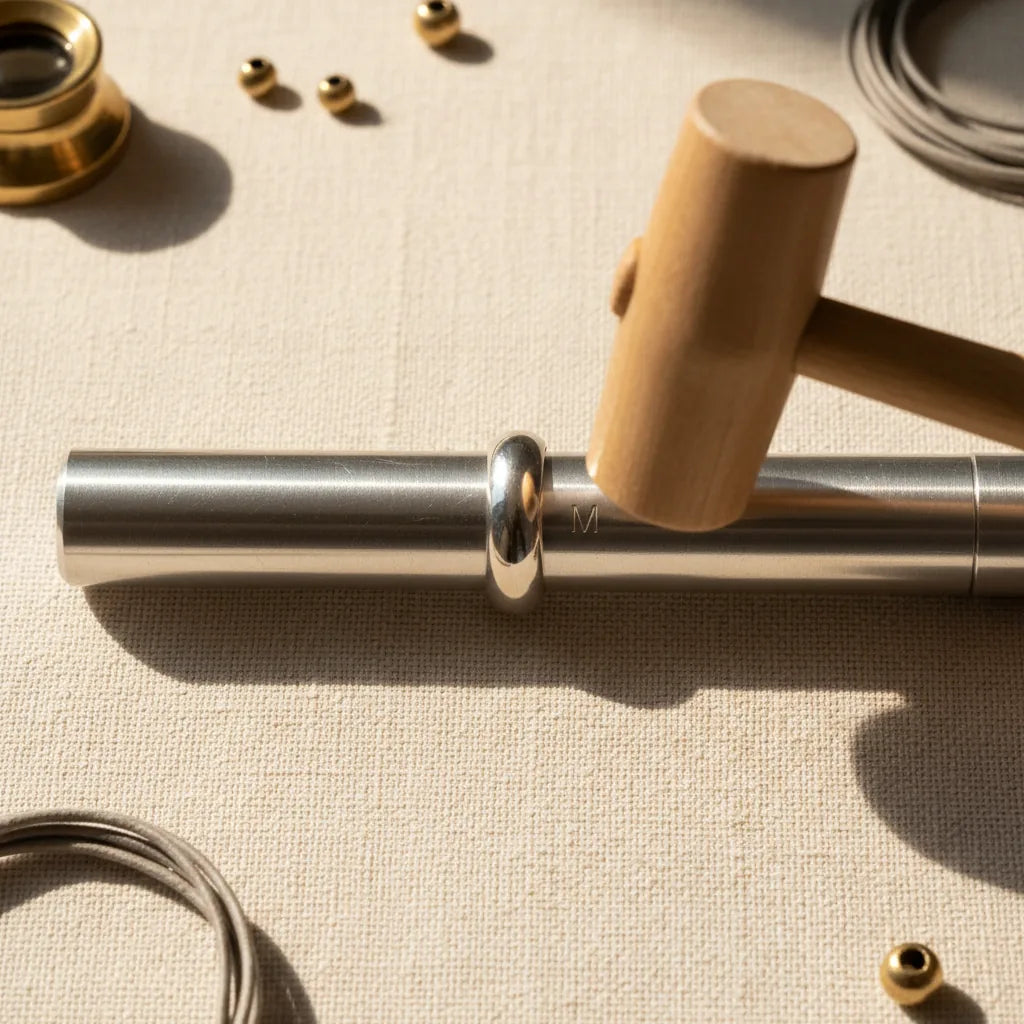
Wood mandrels are the right choice when you're (a) just starting and want low-cost gear, (b) doing finishing work where surface marks matter, or (c) sizing wax models or polished finished rings (you do not want any tool more aggressive than wood touching a polished ring).
For starter benches we stock a couple of size options: the 7" wooden ring mandrel for tight bench setups, the 9" wooden ring mandrel for general use, and a beautiful 12" professional wooden mandrel if you want one mandrel that covers everything from US-1 to a generous men's size.
What I'd put on a starter bench
In priority order:
-
An aluminium sizing mandrel. This is the everyday tool — quick reads, accurate, light. Whichever ring you've just made, the first thing you'll do is slip it onto this mandrel to verify the size before you finish it.
-
A 9" or 12" wooden mandrel. For tapping rings up, holding pieces while soldering, and any work on already-polished surfaces.
-
A steel mandrel. Only when you start doing forming work. A complete beginner can skip this for the first month — buy when you start hammering rings to shape, not before.
-
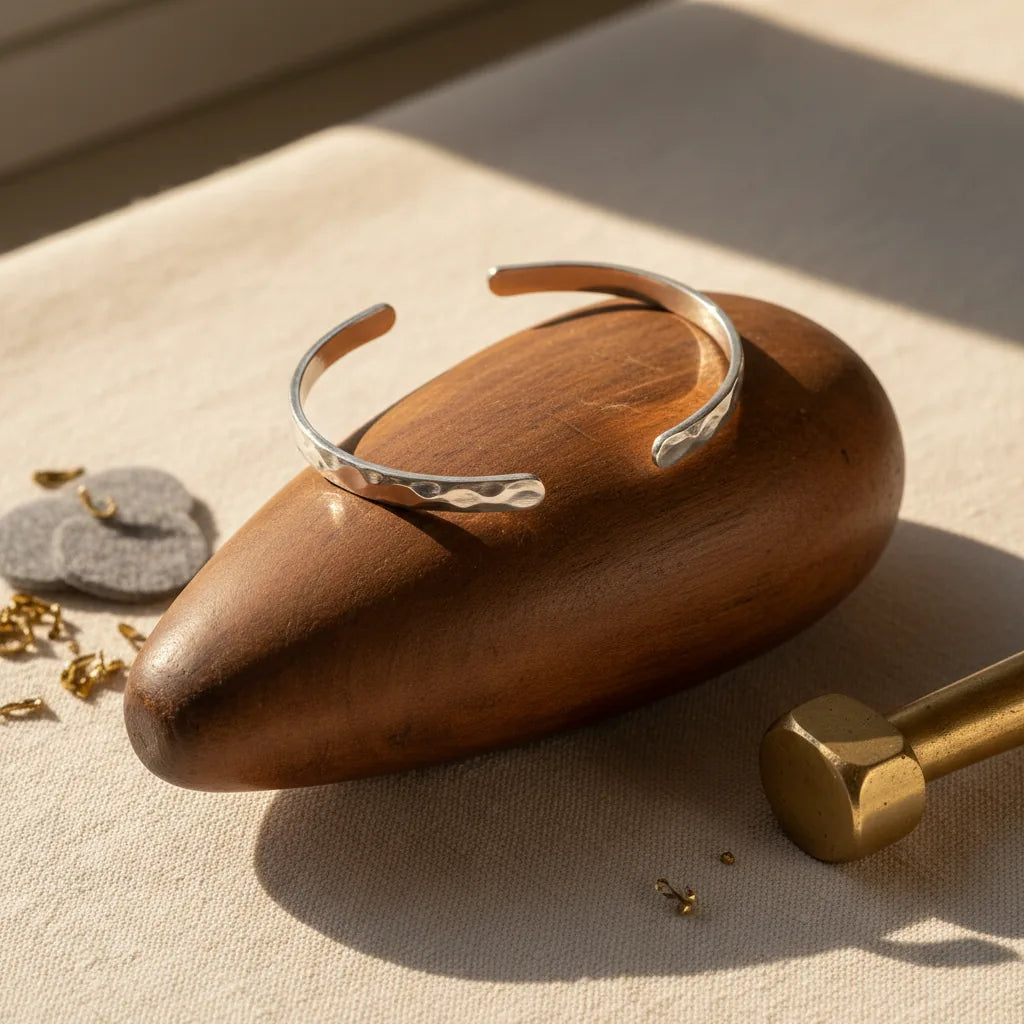
A small bracelet mandrel. Once you're making bangles or wide-band rings, a small bangle mandrel (or a teardrop wooden bracelet mandrel for non-round shapes) opens up a whole category of work.
-
A mini mandrel set for wire work. The 8-piece mini round mandrel set, 1.5–15 mm, with handle and case is the right tool for making consistent jump rings, wire loops, and small bails. Don't substitute round-nose pliers for this — the diameter varies as you grip at different points on the taper.
Storage matters here too: a tangled pile of mandrels in a drawer dings the tapers and degrades the sizing accuracy. The wooden stand for hammers and mandrels keeps them upright and visibly arranged.
UK vs US sizing — quick orientation
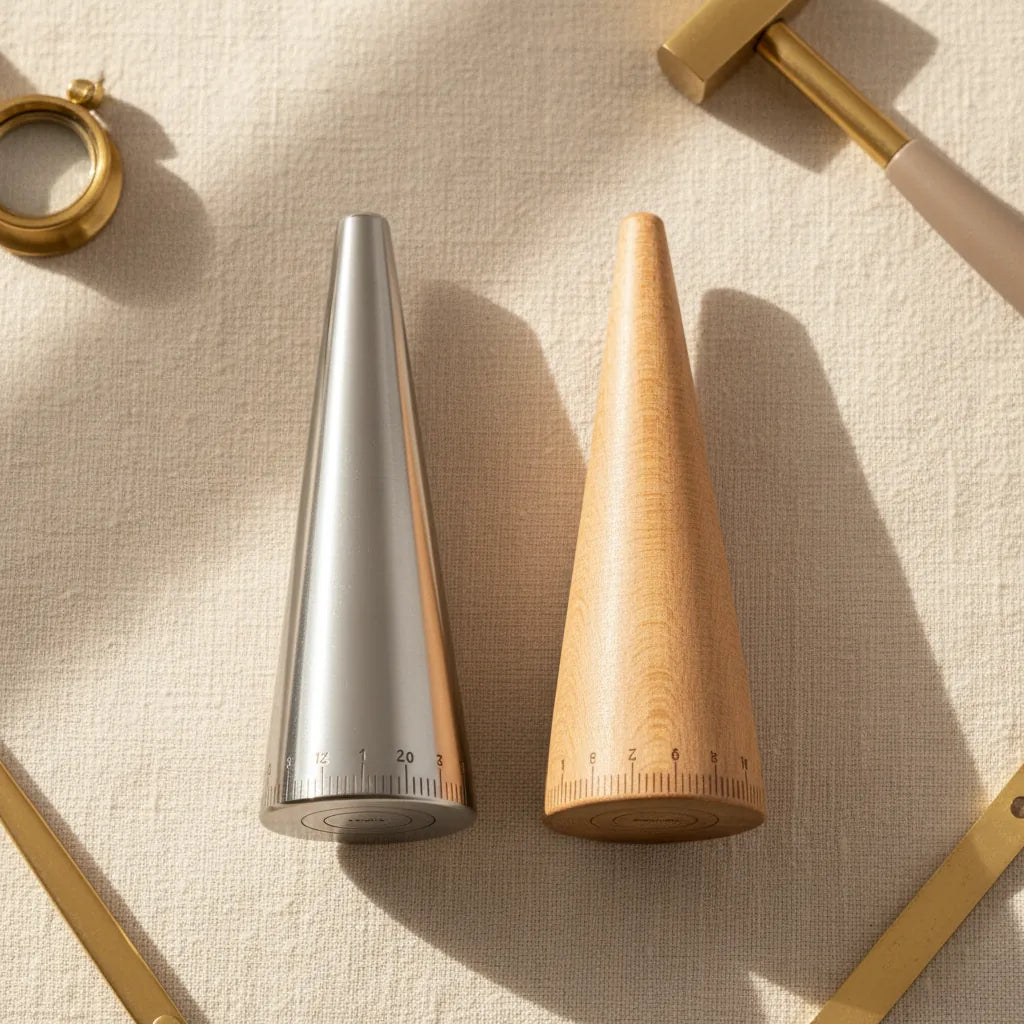
Most jewellery work in the UK is described in UK ring sizes (alphabetical: A–Z+ with half-sizes). Most online tutorials default to US sizes (numerical: 1–13). Most mandrels are dual-marked.
Practical conversions to keep in mind:
- UK J ≈ US 4¾ (small)
- UK M ≈ US 6¼ (women's average)
- UK Q ≈ US 8¼ (men's average)
- UK V ≈ US 10¾ (large)
For accurate work, get a mandrel with marks in both scales. The British Hallmarking Council's published guidance recommends sizing all finished UK pieces in the alphabetical scale — useful precedent if a customer ever queries why their UK ring is listed as "M½" not "6¾".
The one mistake beginners make on their first mandrel
They use the sizing mandrel to form the ring.
The story always goes: you've just soldered a ring shank, the joint cooled, the ring is now slightly out of round. You grab the aluminium mandrel because it's the only one on your bench. You tap the ring to round it out with a rawhide mallet, applying just enough force to make a dent in the aluminium taper at exactly the M-mark.
That dent now reads as a half-size larger on every subsequent ring. You've permanently miscalibrated your sizing mandrel.
The fix: never form on a marked sizing mandrel. Forming goes on the wooden or steel mandrel. Sizing alone goes on the marked aluminium. Cross-contamination of jobs is what wrecks the tool.
Frequently asked
Can I use one mandrel for everything?
For learning, yes — a 9" wooden mandrel covers the basics for the first few months. Once you've made a few pieces and you find yourself wanting to know an exact ring size, the aluminium mandrel pays for itself in a single resize.
Are stepped (multi-diameter) mandrels useful?
For wire wrapping and making consistent loops, yes — the mini round mandrel set is brilliant. For ring sizing they're not the standard tool — use a tapered mandrel for rings.
My mandrel has both UK and US marks but they don't quite line up — is this normal?
Yes — UK and US sizing systems are derived from different historical references. The marks won't sit exactly opposite each other on the taper, but the conversion is consistent. Use one system consistently per piece.
How do I clean a mandrel?
Soft cloth, dry. If sticky residue from solder or flux gets on a steel mandrel, a smear of WD-40 on a rag and a wipe. Never use abrasive — even fine emery will scratch the surface and start the size drift problem.
How long should a quality mandrel last?
Steel: decades. Aluminium: years (assuming you keep it for sizing only). Wood: years to decades, depending on how much hammering you've done on it. A wooden mandrel that's been used as a forming surface for 10 years will have a noticeably different taper from a fresh one.
Where to go next
Start with the 9" wooden ring mandrel if you're at "what mandrel do I need first" — it's £15 and covers months of work. Add the aluminium sizing mandrel when you've completed your first 5 pieces and want repeatable sizing.
Once you're past the basics, the next post — How to size and stretch a ring without distorting the metal — covers the practical technique of actually using these mandrels at the bench.
— K.