

A file is the most-used tool on my bench and the one beginners think about least. People will agonise over which hammer to buy, then grab any old file and wonder why their edges look chewed. The truth is that good filing is 80% of what makes a piece look professional — the difference between "handmade" and "homemade" is almost always in the filing and finishing.
This guide covers what the shapes are for, what the cut grades mean, the difference between cut-steel and diamond, and the three files I'd actually buy first. It sits right after how to use a jeweller's saw in the bench workflow — you saw the shape, then you file it true — and it pairs with everything in the Pliers & Cutters collection.
Needle, hand, or riffler — three families
- Needle files are small (140–160mm), fine, and the workhorse of bench jewellery. One end is a plain tang you hold. A 6-piece diamond needle file set is the standard starting point.
- Hand files are larger, with a wooden handle, for removing metal fast on bigger work — silversmithing rather than benchwork on rings.
- Rifflers are double-ended, curved files for getting into recesses — stone settings, repoussé hollows, the inside of a curl. You don't need these until you're doing setting or repoussé and chasing.
For a first year at the bench, needle files do almost everything.
The shapes, and what each one is actually for
This is the bit that confuses everyone. You don't need all of them — you need to know which profile fits which job.
- Flat (and the half-round's flat face): straight edges, flat surfaces, the outside of a ring shank. The most-used profile.
- Half-round: the flat face for outside curves, the rounded face for inside curves — the inside of a ring, the concave of a leaf. If you buy one file, buy this.
- Round (rat-tail): opening up and truing drilled holes, inside small circles.
- Square: flat-bottomed slots and right-angle internal corners.
- Three-square (triangular): sharp internal angles, cleaning up where two edges meet, V-grooves.
- Barrette (flat with safety back): the back is smooth ("safe") so you can file one surface without marking the one next to it — invaluable near a setting or a finished face.
- Knife-edge: thin wedge for very tight angles and between claws.
The honest shortlist: half-round, flat, and round cover the overwhelming majority of jobs. A six-piece set adds square, triangular and barrette, which you'll grow into. Everything beyond that is for specific techniques.
Cut grades: how coarse, how fine
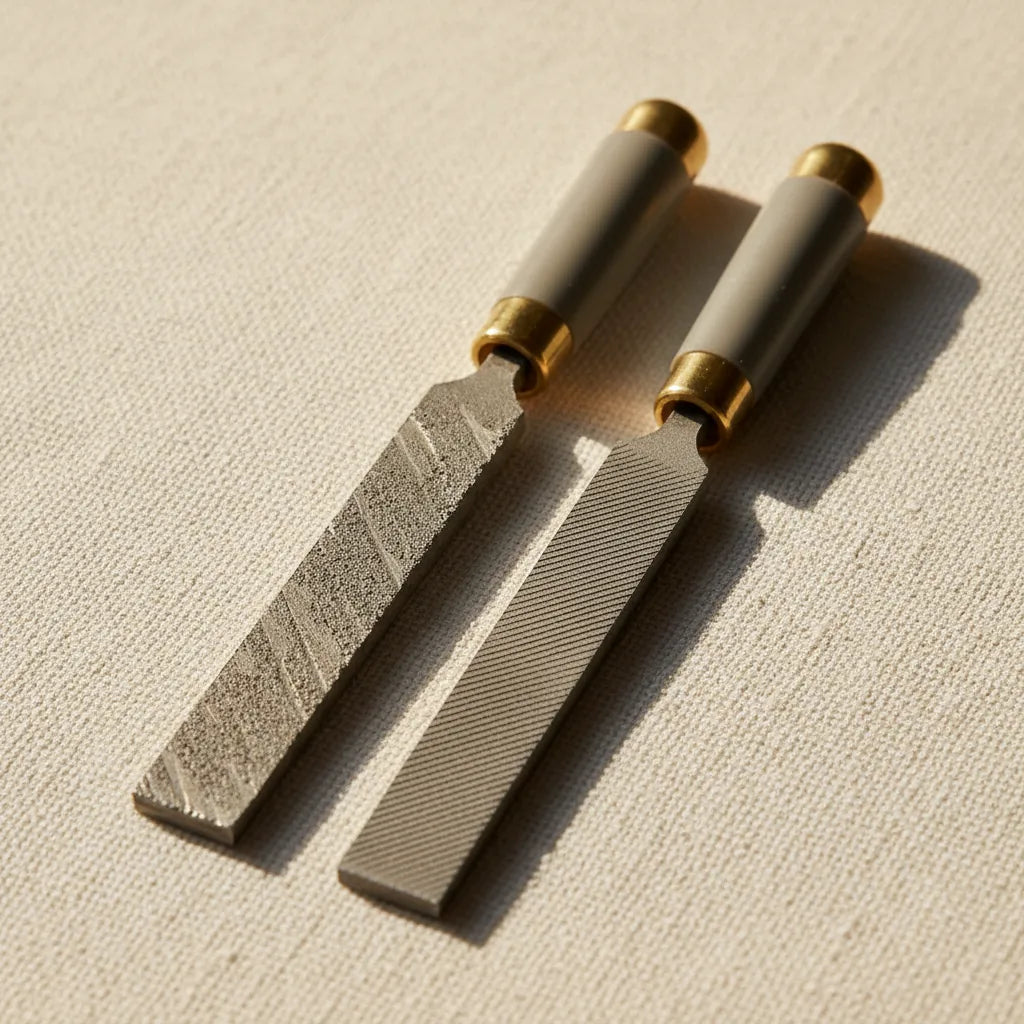
"Cut" is the coarseness of the teeth. Cut-steel files run from cut 00 (coarse) through cut 2 (medium) to cut 4 and finer (smooth). Diamond files are graded by grit instead — our set is 140 grit, a useful medium that removes metal briskly but leaves a surface fine enough to move straight to emery.
The bench logic is simple: coarse to shape, fine to finish. Start with a medium cut to bring the metal to the line, then a finer cut (or the next stage of abrasive) to refine before polishing. Skipping straight to a coarse file and stopping there is why edges look rough — you've left scratches that the polish can't hide.
After filing, the surface still carries fine file marks that need taking out with emery before buffing. That progression — file, emery, polish — is the whole story of how to polish jewellery by hand.
Diamond vs cut-steel — which to buy
- Diamond files (abrasive bonded to steel) cut hard materials cut-steel won't touch — platinum, hard solders, set stones' bearings, even glass and ceramic. They stay sharp for years and don't pin (clog) the way steel can. The trade-off is they can't be re-cut once worn, and very fine finishing is still better with smooth cut-steel.
- Cut-steel files give a finer controlled finish on gold and silver and come in finer grades. The trade-off: they wear, they pin on soft metals, and the cheap ones are inconsistently cut.
For a first set, a 140-grit diamond set is the pragmatic choice — forgiving, long-lasting, and capable across metals. Add fine cut-steel later when you want a glassier pre-polish finish.
How to file so you don't ruin the edge
Technique matters more than the file.
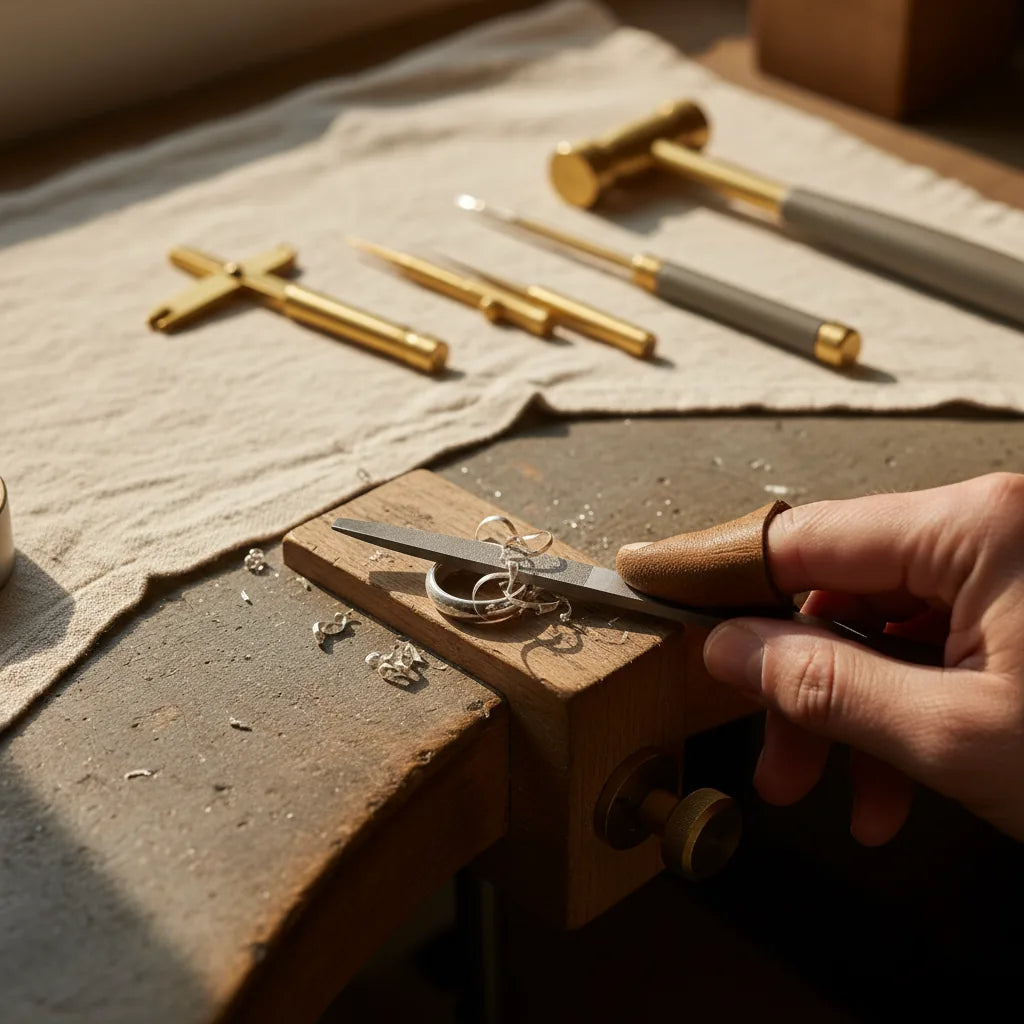
- Cut on the push only. A file cuts on the forward stroke. Lift it on the return — dragging it back rounds the teeth and burnishes the metal instead of cutting. Push, lift, reposition, push.
- Keep it flat; don't rock. Rocking the file rounds over an edge you wanted crisp. For a true flat, draw-file: hold the file across the work and draw it along the edge.
- Long strokes, light pressure. Let the teeth do the work, exactly as with the saw.
- Support the work on a bench pin. Same V-slot you saw over.
- Keep files clean. Soft metals "pin" — bits lodge in the teeth and scratch. Brush across the teeth with a file card or brass brush; a rub of chalk on the file beforehand reduces pinning.
One more thing beginners miss: a separate file for solder and base metals. Filing steel or hard solder with your good silver files dulls them fast. Keep a cheap file for rough work and your good set for precious metal.
Where files fit in the kit
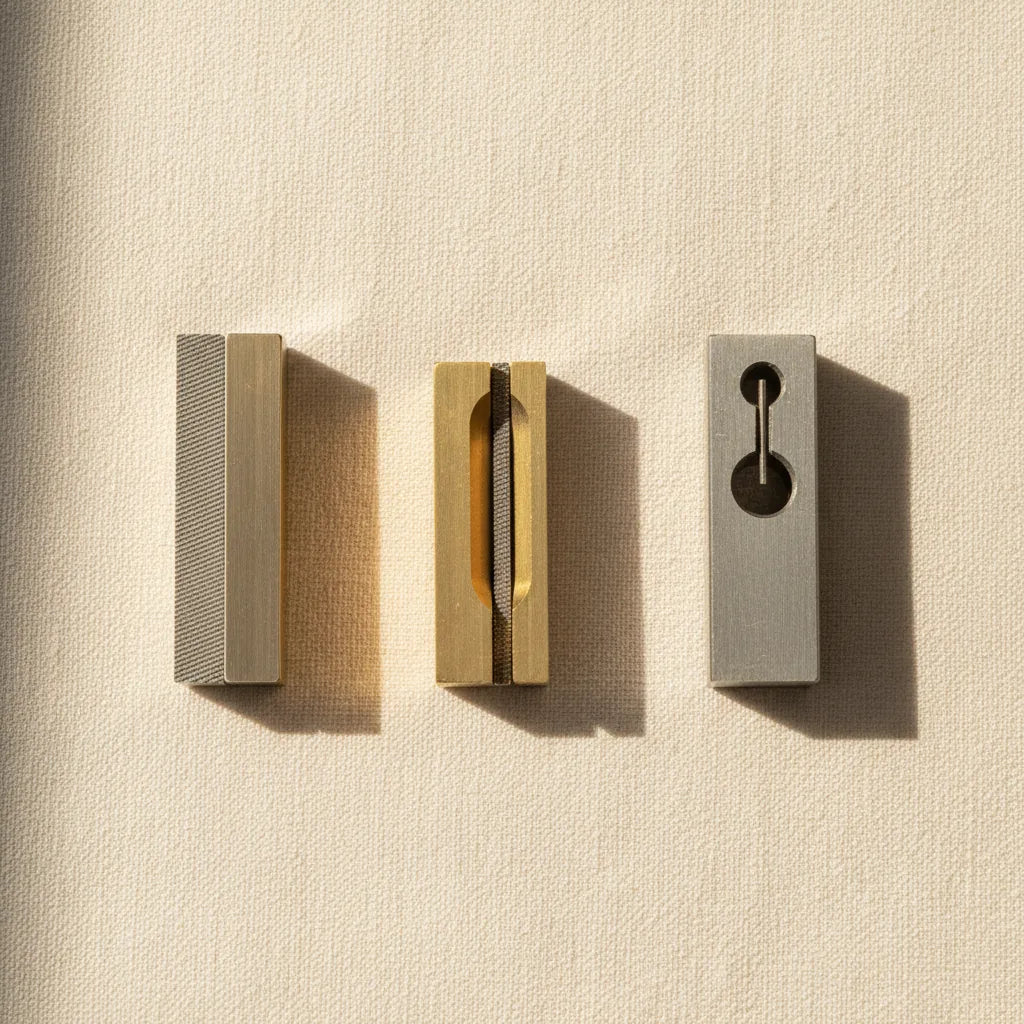
Files are one of the dozen non-negotiables — they're on my list of 12 tools every new silversmith needs for a reason. If you're assembling a bench from scratch, the bench-jeweller starter kit shows where files sit alongside saw, pliers and mandrel. For straight, repeatable mitre and tube cuts, a filing/cutting jig holds the work at a true angle so the file does the rest.
Frequently asked
What needle files should a beginner buy first?
A half-round, a flat, and a round will cover most jobs. A six-piece set adds square, triangular and barrette, which you'll grow into. Start with a 140-grit diamond set for durability across metals.
What's the difference between file cuts 0, 2 and 4?
The number is the coarseness — 00 is coarse and fast, 2 is medium, 4 and up are smooth and slow. Work coarse-to-fine: shape with a medium cut, refine with a finer one before polishing.
Are diamond needle files better than steel?
For durability and cutting hard materials (platinum, hard solder, stone bearings), yes. For the very finest controlled finish on gold and silver, fine cut-steel still has the edge. Most benches use both.
Why do my files leave scratches?
Either the file is too coarse for the finishing stage, or it's "pinned" — clogged with metal that drags. Clean the teeth with a file card and work down through finer cuts before emery and polish.
Which way do you push a needle file?
Cut on the forward push only and lift on the return. Dragging the file back rounds the teeth and burnishes rather than cuts.
Where to go next
Buy a 6-piece diamond needle file set, keep a cheap file aside for solder and base metal, and practise filing a sawn brass edge dead straight before you finish it. Filing is a skill that rewards slow, deliberate strokes.
Before filing comes sawing — how to use a jeweller's saw — and after filing comes the finish, in how to polish jewellery by hand. Browse the full Pliers & Cutters collection for saws, cutters and filing aids.
— K.